

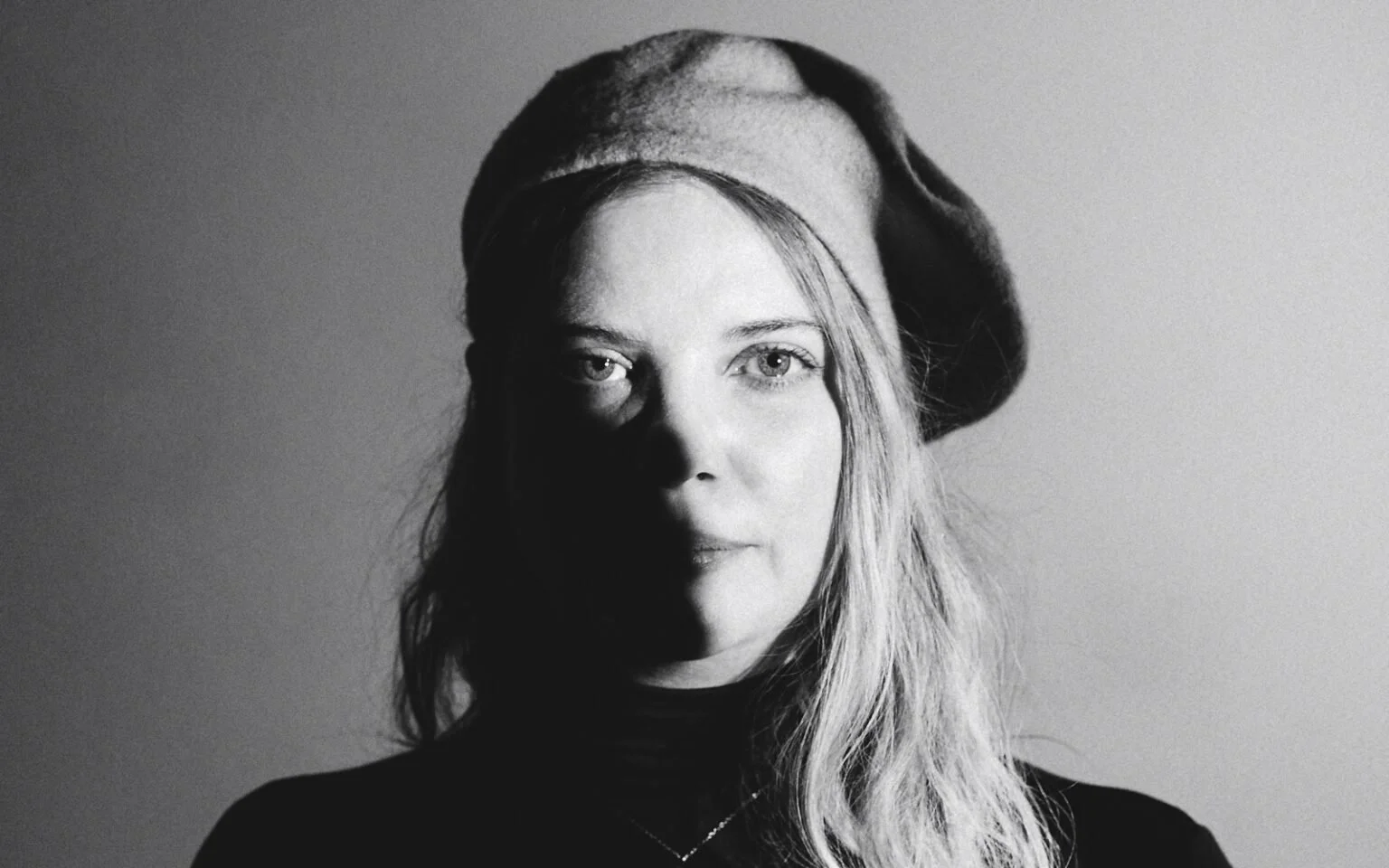
The Calgary singer-songwriter finds clarity with “Eyes Wide Shut.”
by Sofia Dawson
Photos by Heather Saitz
Published on June 10, 2026
From melancholic lyricism to velvet guitar strums, Samantha Savage Smith exemplifies how hope can be gritty, angry, and graceful all at once. Now, with “Eyes Wide Shut,” Smith is taking a stab at what it’s like to exist within the heavy state of a distorted reality. The track sees Smith straying far from her 2011 debut Tough Cookie, integrating tender daydreaming and ambiguity into a deep-cutting self-exploration.
With her live band front and centre – JJ Mayo on pedal steel and Chris Dadge on drums, bass, and synth Smith is able to step back and divulge easily her darkest lyrics to date. As her breathy vocals ring against a pulsing electric guitar, the 38-year old lets her “imagination play,” holding listeners at arms length for her tumultuous free-fall.
Samantha Savage Smith opened up to RANGE about the emotive lyrics and hard-hitting truths that listeners are sure to see in Little Place, her upcoming album.
Where are you right now, and what does an average day in the life of Samantha Savage Smith look like these days as you prepare for the release of Little Place?
Currently on the train heading back downtown from work. These days I’ve mostly been working, caring for my dad, obsessing over my rabbits, and spending a lot of time writing and demo-ing new songs.
“Eyes Wide Shut” introduces listeners into the world of your upcoming album Little Place. Floating between deep cuts and thoughtful inquiry, was this track rooted in catharsis?
All my songs are rooted in catharsis, honestly. Therapy isn’t in the budget, so I’ve gotta exorcise the demons somehow. I felt like “Eyes Wide Shut” was the right tune to give everyone a glimpse into the emotional territory the rest of the album is exploring.
The accompanying music video plays with reflections, shadows, and an ensemble of masked dancers. What drew you to those visual elements? Will listeners find similar themes or imagery throughout Little Place?
We pulled a lot of the visual concepts directly from the song itself, along with a few things that seem to be pretty universal dream experiences. Personally, I never really see faces in my dreams. Most of the time I know exactly who someone is supposed to be, but their face is always blurred or indistinct. There’s something strangely familiar but unsettling about that.
I’ve always found a lot of escapism in my dreams. Sometimes I’ll wake up from one and spend the entire day thinking about it, replaying certain moments and getting lost in whatever feeling it left behind. I think that’s ultimately what I was trying to convey with the visuals and the song itself—a sense of retreating inward and avoiding the things you don’t want to confront. Getting lost in dreams, memories, fantasies, or distractions instead of facing yourself and the harder realities waiting for you when you wake up. It’s not necessarily about running away forever, but about that very human temptation to stay in a place that feels safer and more comforting than what’s actually in front of you.
Can you tell us a bit about the significance of the alarm clock in the opening of the video? Does the time hold any personal meaning? Should fans be reading into it?
I think a lot of people experience scrambling clocks in their dreams—I know I certainly do. I was pretty intent on having that as the opening shot because, for me, a distorted clock is usually the moment I realize I’m dreaming. That’s when things get really interesting. My hope was that it would have a similar effect on the viewer: a little signal that the normal rules no longer apply and an invitation to step into the bizarre sequence that’s about to unfold. I wanted viewers to feel like they were crossing a threshold.
As for the time… we were just being cheeky and wanted to sneak in a little Easter egg for the album release date. Whether that’s clever foreshadowing or shameless subliminal advertising is up for debate.
The lyrics to “Eyes Wide Shut” ask, “Or was it just in my mind? It could have been a dream.” While the video itself unfolds like a dream sequence, was there a sense of vulnerability in exploring what you’ve described as a “distorted reality”?
There’s definitely vulnerability in that, yeah. Not necessarily in a dramatic sense, but in allowing yourself to not have a clear version of events, or to admit that your perception of something might not be reliable. I think that’s what makes it feel a bit exposed—it’s less about answers and more about sitting in the ambiguity.
The video was shot entirely in black and white — a visual approach you’ve also emphasized across your social media. What inspired that continued creative choice?
My decision to go with black and white across the board was mainly because I felt it conveyed the right mood to sit alongside the songs. When I look at old black and white photographs, they evoke this strange mix of curiosity and grief. There’s this fascination with a world that no longer exists, but also a reminder that everyone in those photos is gone and that our time here is finite too. They have a way of making me think about memory, mortality, and the passage of time.
On a practical level, I was also collaborating with a lot of different people on the visuals, and I wanted some kind of unifying thread to tie everything together. Keeping everything in black and white became that constraint and helped maintain a cohesive visual identity across the project.
How did the writing process behind “Eyes Wide Shut” compare to that of “My Friends”? Did one come more naturally than the other?
I’d say both were pretty similar in the sense that they were written the same way: sitting on a living room floor late at night, then spending the next few months obsessing over and rewriting lyrics. That’s usually how it goes for me. The initial spark happens fairly quickly, but figuring out exactly what I’m trying to say can take a lot longer.
The one thing that was different about “Eyes Wide Shut” is that I knew almost immediately what I wanted the production to sound like. Usually I’m still discovering the arrangement as the song takes shape, but with this one I could hear it from the start. That wailing, siren-like sound that weaves through the song (which is actually pedal steel, believe it or not) was in my head the moment I played those opening chords. By the time we got in the studio, it’s like the song showed up with its own instructions. Dadge and I cranked out the vast majority of the parts in one sitting. It’s pretty thrilling when that happens.